
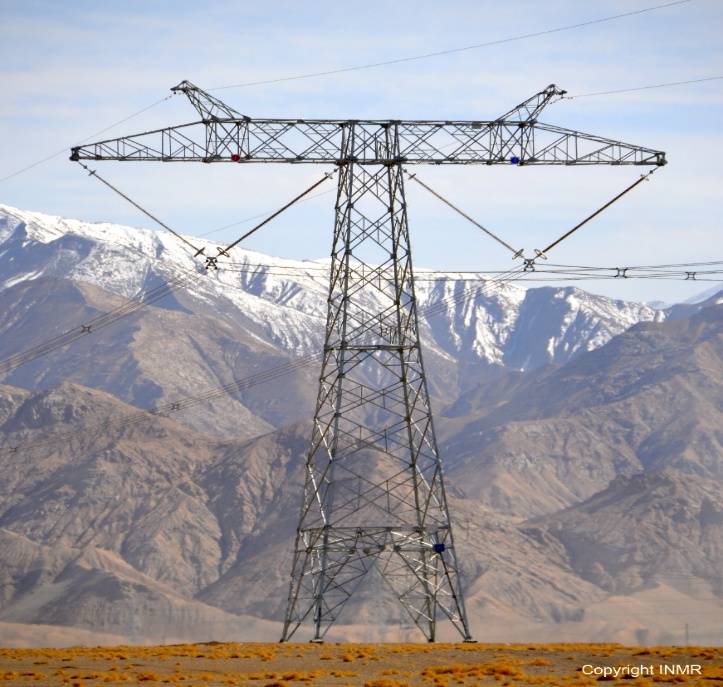
Transmission Line Insulators
Advanced composite insulators for high-voltage transmission lines from 69kV to 765kV — lightweight, maintenance-free, and engineered for North American environmental conditions.
.jpg)
Line Post Insulators Catalogue
69kV to 345kV
Leading Innovation in Composite Insulation Technology
SHEMAR Composite Insulators
Delivering Superior Aging Resistance and Longevity in Reliability Performance
SHEMAR composite insulators embody the latest innovations in composite insulation technology, combining world leading material science development, cutting edge design technology and state of the art manufacturing and rigorously monitored quality control.
We understand the crucial impact that insulators can have on the long-term performance of transmission lines, which is why at SHEMAR we have prioritized creating composite insulator products and solutions that offer unparalleled, reliability, aging resistance and exceptional performance.
One Piece Features without Joints
SHEMAR's composite transmission line post insulators are designed with advanced one-piece housing technology that eliminates internal interfaces, providing superior bonding performance and protection against erosion damage. The housing is directly vulcanized to the core, resulting in a single, seamless HTV silicone rubber housing (sheath and sheds) that is impregnable to moisture ingress, and provides ultimate defense against environmental factors.
During manufacturing a single-shot injection molding process is used, which applies high pressure and temperature to ensure a robust, one piece housing that is chemically bonded to the core rod. This one piece housing design features only one internal interface, i.e. the bonding interface between the core rod and the housing, which significantly reduces sensitivity to tangential electrical field stress that can cause erosion damage.
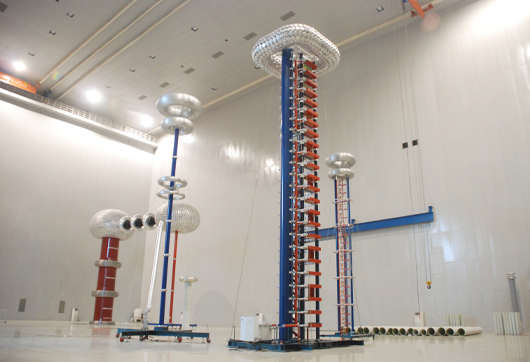
Integrated injection machine
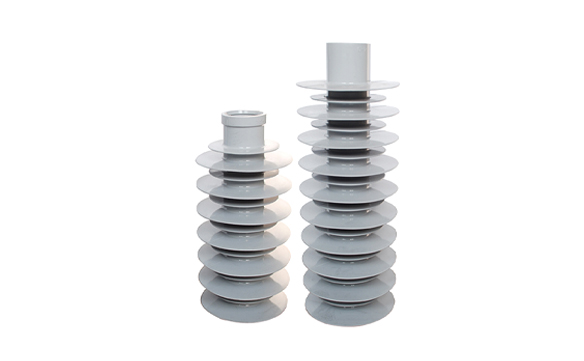
Excellent bonding performance
Excellent Bonding between Core and Housing
SHEMAR's injection molding manufacturing process also creates an unmatched quality of chemically bonded interface between the rod and along the longitudinal fitting and housing, which eliminates the risk of internal tracking, as well as the end fitting of the composite insulator. The bond between the silicone rubber housing and fiberglass rod is also mechanically stronger than the inherent shear strength of the silicone rubber, ensuring an impenetrable and reliable insulator.
Impenetrable Triple Point
SHEMAR's composite transmission line post insulators feature an innovative and unique impenetrable triple point. This is achieved by using a HTV silicone rubber Entering and Venting (E&V) design around the metal end fitting, along with an additional sealing system to prevent water and contamination and protect the sensitive triple junction zone (where metal fitting, core rod/silicone housing meet).
Maximized Mechanical Integrity
To ensure uniform stress distribution and maximized mechanical integrity of the finished insulator a circumferential, multi-step crimping system is used for the attachment of metal end fittings to the FRP core. Each crimping process is monitored for acoustic emission, crimp pressure and travel distance of compression dies as control parameters.
In addition, we also conduct mechanical simulations based on the actual crimping process, material parameters and product design, in order to confirm that there are no performance risks by checking the stress nephogram of each component. This process along with corresponding laboratory tests ensures a safe installation and operation of insulators during their service.
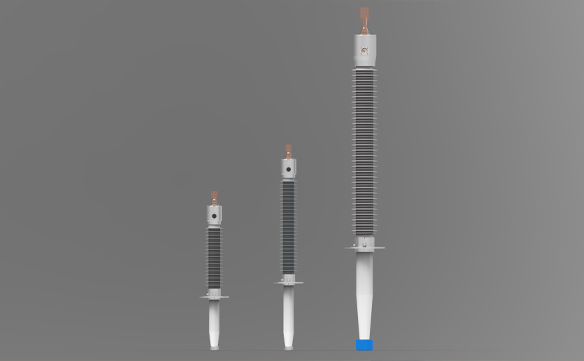
Stress nephogram of line post insulator
Optimal Electric Field Grading - No Water Droplet Corona
At SHEMAR, our composite insulators are carefully engineered to eliminate RIV and corona (under both dry and wet conditions). Rather than utilizing a one-size-fits-all approach, we customize each insulator design based on the specific user's actual application engineers than utilizing a one-size-fits-all approach, we utilize state-of-the-art 3D modeling and FEA simulation to determine the optimal size and placement of corona rings based on the specific structure design and overall assembly configuration.
It is ensured that the maximum electric field criteria of ≤ 4.2 kVrms/cm on silicone rubber housing recommended by EPRI TR102151 is maintained on all our designs and thus the phenomenon of water droplet corona (WDC) is completely eliminated, reducing the risk of material rubber housing at the triple point connection zone which works to decrease the electric field strength at the overmolded and the silicone surface itself.
Furthermore, all of our corona rings are designed with an open (c-section) style, making them easy to install and replace.
Overall electric field simulation
Triple point electric field simulation
Designed to Endure Severe Environments
SHEMAR's composite transmission line post insulators are created to endure even the most severe service conditions, such as coastal salt fog, dust and industrial contamination without impairment in performance.
Superior hydrophobicity retention and short hydrophobicity transfer and recovery times prevents the formation of conductive layer and the excellent tracking and erosion performance of the housing provides an additional defense mechanism.
The insulator housing features alternating weather shed spacing with both standard and creepage factor (CF) parameters, to ensure maximum effectiveness in self-cleaning performance and resistance to contamination, ice and leakage currents. In various environmental applications. All of our housing shed profile designs adhere to the recommendations given in IEC 60815-3 and have a minimum 3mm sheath thickness.
Materials and Components
Best-in-Class Silicone Rubber Housing
The special HTV silicone rubber for SHEMAR composite insulator housings has been scientifically engineered as a result of extensive R&D in order to overcome the various aging, electrical and physical degradation mechanisms and deliver the best-in-class aging resistance and long term reliable performance.
SHEMAR carries out the entire process of HTV silicone rubber manufacturing in-house from raw material sourcing to mixing with special additives and fillers which achieves the best UV, tracking and erosion resistance, weatherability and contamination resistance performance. SHEMAR's HTV silicone rubber formulations have a long service record of successfully performing in some of the most extreme and demanding environments without degradation.
Fracture-proof Core Rods
The fiberglass core for SHEMAR composite transmission line post insulators is manufactured from boron-free, corrosion resistant ECR glass fiber and epoxy resin. By using this ECR boron-free formulation, the core rods have excellent electrical integrity, and they are extremely resistant to hydrolysis and stress corrosion attack, which mitigate the risk of brittle fracture. Additionally, the core rods can withstand a 48 hour nitric acid test at 90°C (194°F). SHEMAR manufactures all of its fiberglass core rods in house using a high-quality pultrusion process.
Voltage Classes
69kV - 138kV
Low to medium voltage transmission line insulators designed for reliable performance in standard applications.
- Composite insulators
- One-piece housing design
- Excellent hydrophobicity
- Lightweight design
230kV
Medium voltage transmission line insulators for standard distance power transmission.
- Composite insulators
- Advanced bonding technology
- Superior mechanical strength
- Pollution-resistant design
345kV
High voltage transmission line insulators for long distance power transmission.
- Advanced composite insulators
- Optimal electric field grading
- Extreme weather resistance
- Maximum mechanical integrity
Product Attachments
Download technical specifications, installation guides, and other product-related documents for our transmission line insulators.
Product Catalog
Comprehensive catalog of all transmission line insulators by voltage class.
Technical Specifications
Detailed technical data sheets for each voltage class of insulators.
Installation Guide
Step-by-step instructions for proper installation of transmission line insulators.
Test Reports
Certification and test reports for transmission line insulators.